How to Read Smartphone Reviews: Specs, Scores, Compare
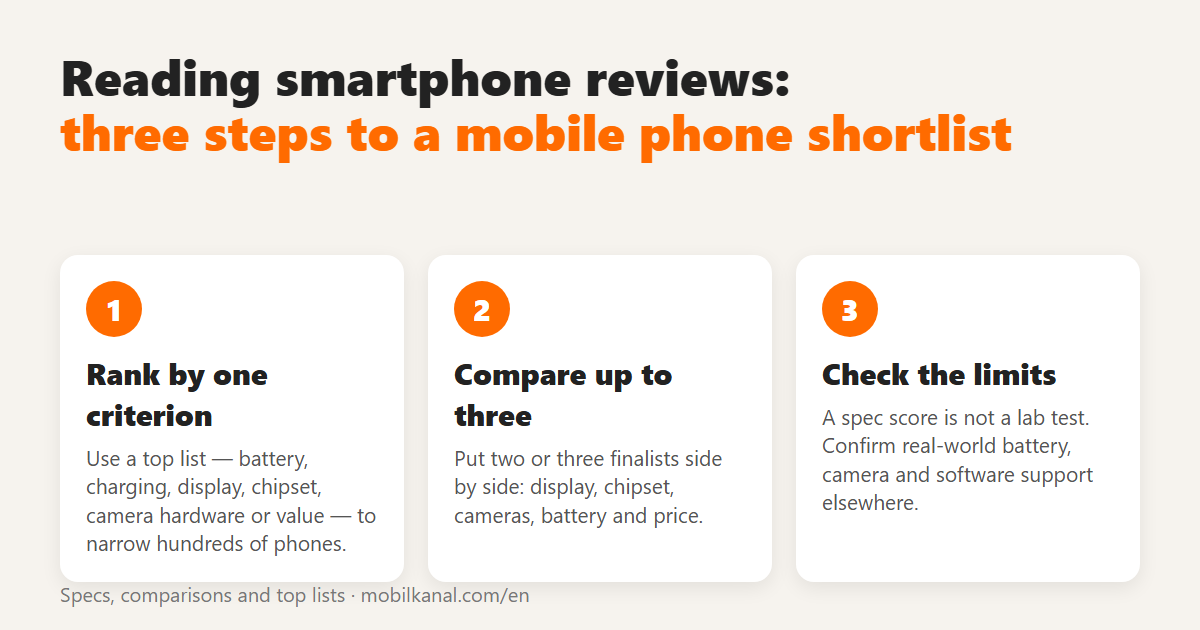
Reading smartphone reviews should make a decision easier, yet many shoppers finish ten tabs later more confused than when they started. One page praises a handset for its camera, another calls the same model average, and the numbers in between never quite line up. The problem is rarely the phone. It is usually the way the information is presented and the way we read it.
This guide explains how to read a spec sheet, how to tell a spec-based rating from a laboratory test, and how to turn a long list of options into a sensible mobile phone shortlist. Along the way we use one transparent example: the catalog behind these smartphone reviews publishes the exact weights of its 0 to 100 Spec Score, which makes it a handy way to see how a rating is actually built.
Why smartphone reviews so often disagree
Two writers can look at the same device and reach different verdicts without either being wrong. They may weigh different things, test in different conditions, or simply write for different readers. A mobile phone is a bundle of trade-offs, and every review decides which trade-offs matter most.
Before you trust any verdict, ask three quick questions:
- What is the rating based on? Hands-on testing, published specifications, or a mixture of both.
- Who is it written for? A gamer, a photographer and a commuter need different things.
- Is the method explained? A score with no stated formula is an opinion, not a measurement.
If a page cannot answer these questions, treat its conclusion as one voice among many. Good smartphone reviews tell you what they measured and, just as importantly, what they did not.
What a mobile phone spec sheet really tells you
A specification table is the most honest starting point because it lists facts rather than impressions. Still, the facts need translating. A catalog such as the one we are using here records the screen, chipset, memory, cameras, battery, connectivity, size, weight, operating system and release date for every listed handset. Each of those lines answers a different everyday question.
Screen and chipset
The display entry tells you the panel type, such as OLED or AMOLED, plus the refresh rate and resolution. A higher refresh rate makes scrolling feel smoother, while the panel type affects contrast. The chipset line is a rough guide to speed and age, because newer generations usually handle heavy apps and games with less effort.
Memory, battery and connectivity
RAM and storage decide how many apps stay open and how many photos you can keep. Battery capacity, measured in mAh, is only half the story; charging power in watts matters just as much if you hate waiting at a wall socket. Finally, check connectivity such as 5G, Wi-Fi, Bluetooth and NFC, since contactless payments and fast mobile data depend on them.
Spec-based smartphone reviews versus lab tests
This is the distinction that clears up most confusion. A laboratory test measures something: real battery runtime, screen calibration, speaker output, low-light photo quality. A spec-based rating, by contrast, takes the published numbers and scores them with a formula.
Neither approach is better in every case. Lab work captures how a mobile phone behaves in the real world, but it is slow and covers only a handful of devices. A formula can rank hundreds of handsets consistently, yet it cannot see anything that is not written in the specification.
- Lab tests are deep, narrow and expensive to repeat.
- Spec-based ratings are broad, consistent and quick to compare.
- The best habit is to use the broad view to find candidates and the deep view to confirm them.
The catalog discussed here is upfront about this. Its reviews are built from published specifications under headings such as design, display, performance, camera and battery. They are not laboratory results, and they never claim to be. That honesty is worth looking for in any source of smartphone reviews.
How a Spec Score is built: a worked example
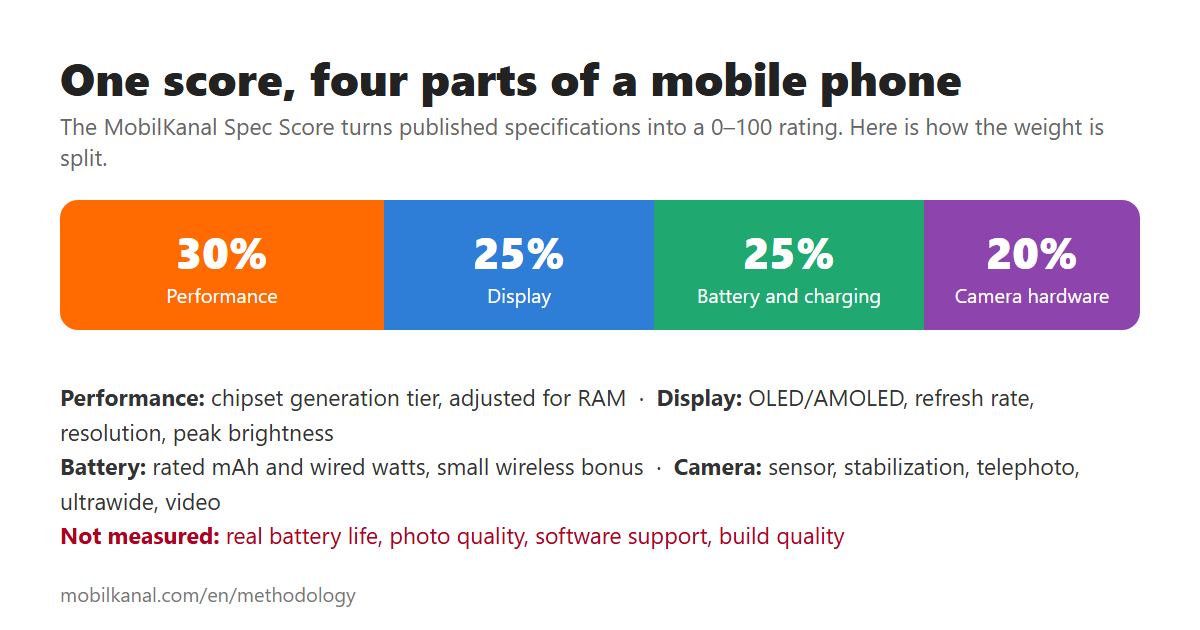
A rating becomes much easier to trust once you can see the recipe. The MobilKanal Spec Score is a number from 0 to 100, calculated from published specifications and split into four weighted parts.
- Performance, 30%. Based on the chipset generation tier and the RAM setup.
- Display, 25%. Rewards OLED or AMOLED panels, refresh rates of 90, 120 or 144 Hz and above, resolution and peak brightness.
- Battery and charging, 25%. Capacity in mAh makes up roughly 65% of this part, wired charging power in watts about 35%, with a small bonus for wireless charging.
- Camera hardware, 20%. Looks at main sensor resolution and size, optical image stabilisation, telephoto and ultra-wide lenses, and the highest video mode.
Notice what this tells you. Performance carries the most weight, so a handset with a strong chipset gains ground quickly. Camera hardware counts for the least, and even then only the hardware is scored, not the pictures it produces. If you care mainly about photography, you now know to discount the overall number and look closer at the camera line.
Whenever a site publishes its weights like this, you can adjust the score to your own priorities in your head. That is the real benefit of transparency.
What a Spec Score cannot measure
Every rating has blind spots, and a good one lists them. The Spec Score leaves out real-world battery life, display calibration, speaker and call quality, image processing, low-light results and practical video stabilisation. It also ignores software support and update policy, build quality, repairability and how prices change over time.
Those omissions matter, because several of them decide whether you will still enjoy a mobile phone two years from now. A handset with excellent hardware but a short update promise can age badly, and no formula based on a spec table will warn you.
The sensible way to use such a number is as a filter, not a verdict. Scores that are far apart usually reflect a real hardware gap. Scores that sit close together are a signal to stop looking at the headline figure and start reading the details.
Building a mobile phone shortlist in five steps
With the theory in place, here is a practical routine you can repeat for any purchase. It works whether you are choosing an inexpensive handset for a parent or a flagship for yourself.
- Step one: set a budget range. Decide on a ceiling before you fall in love with a device.
- Step two: pick your two or three priorities. Battery, camera, display or raw speed rarely all matter equally.
- Step three: filter by brand if you have a preference. The catalog lists more than 900 models from over 100 brands, with Samsung, Apple, Xiaomi, Oppo and vivo among those with the most entries, so filtering keeps the list manageable.
- Step four: use ranked lists to find candidates. Pick five or six handsets that score well on the things you chose.
- Step five: compare the finalists closely. Narrow five down to two or three.
If you want to start from the editorial side of our own site, you can browse our phone reviews and apply the same method there.
Using side-by-side compare pages
A comparison table is where a shortlist becomes a decision. The compare feature in this catalog places two or three phones next to each other and lines up the screen, chipset, camera, battery and price. Seeing the rows aligned removes the guesswork that comes from flipping between separate pages.
To get the most from it, follow a short routine:
- Choose handsets in the same price band, otherwise the cheaper one will always look worse.
- Scan for the rows where the gap is large rather than reading every line.
- Ask whether that gap affects your daily use. A bigger charging wattage helps a busy commuter far more than a slightly higher resolution.
You can also compare phones side by side on our own pages when you want a second opinion on the same finalists.
Reading mobile phone value scores and prices
Price changes everything, which is why many shoppers look for a value figure. In this catalog, the value score applies only to handsets with a current price in Turkey. It divides the Spec Score by a smoothed function of the price, then converts the result into a percentile among all priced phones. A value score of 80, for example, means the handset offers more specification per unit of money than roughly 80% of priced phones.
That is a useful idea, but keep its limits in mind. Prices are listed in Turkish lira, taken from the Turkish market where a price exists, and some lists convert Turkish market prices into dollars. Because retail prices move, you should always confirm the latest figure with the seller before buying.
Think of the value score as a pointer, not a promise. It tells you where to look first, and your own priorities tell you when to ignore it.
Where Top lists, news and the glossary fit in
Not every question needs a full review. Sometimes you only want to know which handsets have the biggest batteries or the fastest charging. The catalog answers this with Top lists, each of which ranks phones by a single measurable criterion.
Examples include highest-scoring phones by specifications, biggest batteries, fastest charging, best display specifications, fastest by chipset and memory, strongest camera hardware, and best value by specs per price. There are also budget lists for phones under $300, $500 and $800.
News and the glossary
The news section covers launches, leaks and industry developments, with the device specifications and background included in each story. When a term trips you up, the glossary explains more than 300 entries in plain English, from 2G through AMOLED and Wi-Fi to Zigbee. Reading a few of these definitions before shopping makes every spec sheet far less intimidating.
One honest note: the site also mentions a forum, but it is marked as coming soon, so do not expect community discussion there yet. If you want more structured advice in the meantime, read more buying guides on this site.
Frequently asked questions
Are spec-based smartphone reviews as reliable as lab tests?
They answer a different question. Spec-based smartphone reviews are reliable for comparing hardware consistently across many models, but they cannot confirm real battery life, photo quality or software polish. Use them to build a list, then look for hands-on testing before you buy.
What does a Spec Score of 80 mean?
It means the published specifications of that mobile phone earn a high mark under the formula: performance, display, battery and charging, and camera hardware. It does not mean the phone is 80% good in daily use, because many real-world factors are never measured.
How many phones can I compare at once?
The compare page in this catalog supports two or three phones side by side. That is usually enough, since a final decision between more than three handsets tends to be a sign that the shortlist needs another pass.
Should I trust the prices shown?
Treat them as a guide. Prices in the catalog are in Turkish lira from the Turkish market where available, and they change over time, so confirm the current figure with the retailer before paying.
What if a mobile phone I want is missing?
The catalog does not guess unknown values; missing or unverified fields are left blank. Its FAQ page explains how to request a model that is not listed yet, which is better than relying on a guessed spec sheet.
Conclusion
Smartphone reviews are most useful when you know what sits behind the number. Learn to read a specification table, separate formula-based ratings from laboratory work, and use published weights to adjust a score to your own needs. Then build a short list, compare the finalists side by side, and confirm the price before you commit.
Used this way, a catalog with a transparent Spec Score is a sensible first step rather than a final answer. Pair it with hands-on impressions, and your next mobile phone purchase will rest on evidence instead of guesswork.