iPhone 17 Pro Review: Aluminium, a Vapor Chamber and a Bigger Telephoto
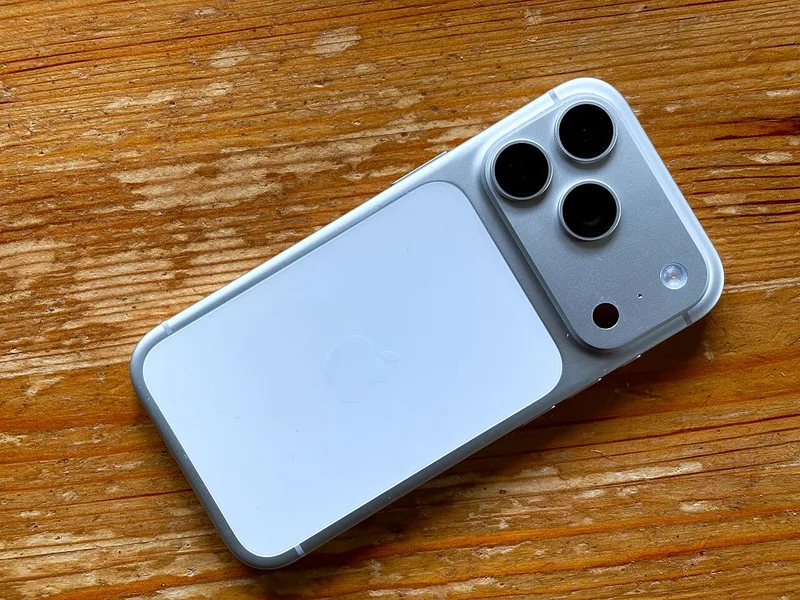
The iPhone 17 Pro and iPhone 17 Pro Max, introduced on September 9, 2025 and released on September 19, 2025, made the biggest visual change to Apple's Pro line in years. The titanium sides of the previous generation were replaced with an aluminium unibody, the camera bump became a wide horizontal plateau, the telephoto lens was rebuilt around a much larger sensor, and a vapor chamber arrived to keep the new A19 Pro chip cool. A year on, Apple has moved its Pro line forward again, and the 17 Pro was retired from Apple's lineup on September 9, 2026, when the iPhone 18 Pro was announced. That makes this an ideal moment to look back at what the 17 Pro offered, who it suited, and whether it is worth seeking out as a previous-generation buy. This page is based on Apple's published specifications and is not a lab test.
A New Design, and a Change of Metal
The 17 Pro is the first Pro iPhone with an aluminium chassis. Earlier Pro models used stainless steel up to the iPhone 14 Pro and titanium from the iPhone 15 Pro onwards. The new unibody is a single piece of aerospace-grade aluminium that connects the sides and the back, and the sides are more rounded than before. A pane of glass on the back makes wireless charging possible. Measurements are 150.0 x 71.9 x 8.75mm and 206 grams for the Pro, and 163.4 x 78.0 x 8.75mm and 233 grams for the Pro Max.
The change is not just cosmetic. Aluminium conducts heat far better than titanium, and Apple built the vapor chamber directly into the frame to take advantage of that. The colour options also broke with tradition: Cosmic Orange, Deep Blue and Silver, with no neutral dark option, which is a first for a Pro iPhone. One reported downside is that the coloured finish on the aluminium can wear at the lip of the camera plateau, exposing the lighter metal underneath, and some owners have described the effect online as "scratchgate". Whether it bothers you is largely about how you treat your phone and whether you use a case.
Display
The Pro has a 6.3-inch Super Retina XDR OLED display at 2622 x 1206 resolution and 460 pixels per inch; the Pro Max has a 6.9-inch panel at 2868 x 1320, also 460 ppi. Both use ProMotion adaptive refresh rates up to 120Hz, an always-on display that drops to 1Hz, wide P3 colour, and a typical contrast ratio of 2,000,000:1. Brightness is quoted at 1,000 nits typical, 1,600 nits peak for HDR content, and up to 3,000 nits peak outdoors, with a 1-nit minimum for dark rooms. Apart from the size, the displays are the same as the standard iPhone 17's, which means the Pro is not distinguished by its screen; its advantages lie elsewhere. The 6.3-inch model is a comfortable one-handed size for most people, while the Max is better for video, reading and gaming.
Chip, Memory and Cooling
Inside both phones is the A19 Pro with 12GB of LPDDR5X memory, alongside Apple's new N1 networking chip for Wi-Fi and Bluetooth. Apple kept a Qualcomm Snapdragon X80 modem for cellular rather than using its newer in-house modem found in the iPhone Air. Storage starts at 256GB and goes to 512GB, 1TB and, on the Pro Max only, 2TB.
The cooling design is the story here. The vapor chamber is a sealed, thin chamber containing a small amount of water that cycles between liquid and gas to move heat away from the chip. Apple claims up to 40 percent better sustained performance than the iPhone 16 Pro, which addresses the way phones slow down under long gaming sessions or video editing. That is a manufacturer claim, and we have not verified it ourselves, but the underlying principle is sound and it is a meaningful upgrade for anyone who pushes their phone hard. If you want to understand what throttling is and why it matters, our article on thermal throttling and cooling explains it clearly. The A19 chips also include Memory Integrity Enforcement, a hardware and software defence designed to make certain kinds of memory-based attacks harder to carry out, which Apple says is aimed at sophisticated spyware.
Cameras
The rear camera system consists of three 48MP lenses. The Fusion main camera is 24mm equivalent at f/1.78, the ultrawide is 13mm at f/2.2, and the telephoto is 100mm at f/2.8. The telephoto is the headline. It uses a tetraprism design that provides 4x optical zoom, and because the sensor is 48MP, Apple can crop into the centre to produce an effective 8x zoom that it describes as optical-quality. That gives smoother steps between 1x and 8x without relying on digital enlargement until you go beyond that. A LiDAR scanner is included, and video capture includes Dolby Vision, ProRes and ProRes RAW.
One notable removal is Night mode portraits, which were available on Pro iPhones from the iPhone 12 Pro through the 16 Pro but were dropped on the 17 Pro models. If you photograph people in dim restaurants, that is worth knowing. The front camera is a new 18MP Center Stage camera with a square sensor at f/1.9, which allows you to rotate the framing between portrait and landscape without turning the phone, and a Dual Capture feature that records from the front and rear cameras at the same time. This makes the phone attractive for creators who want to film themselves and the scene together.
Battery and Charging
Apple does not headline battery capacity, but published figures list the Pro at 3988mAh with a physical SIM (4252mAh in eSIM versions) and the Pro Max at 4823mAh with a physical SIM (5088mAh in eSIM versions). At launch, Apple described the Pro Max as offering the longest battery life of any iPhone to that point, up to 39 hours of video playback. Charging is fast over USB-C, reaching 50 percent in about 20 minutes with a 40W or higher adapter, and MagSafe and Qi2 wireless charging are supported.
Connectivity and Durability
Connectivity is thorough: Wi-Fi 7, Bluetooth 6.0, ultra-wideband, Thread, NFC, and USB-C at 10Gbps, which is fast enough to move large video files quickly. Satellite features let you send Emergency SOS, messages and Find My location updates when you are out of cellular range, though with limited availability. Water and dust resistance is IP68, rated to 6 metres for 30 minutes. SIM support varies by region, with dual eSIM in the United States and several other markets, and a physical nano-SIM plus eSIM elsewhere. The phone launched with iOS 26, and Apple has historically supported iPhones with updates for many years.
Who It Suited, and Who Should Buy It Now
The 17 Pro was aimed at people who wanted the best camera flexibility, sustained performance and battery life from an iPhone and were willing to pay for it: creators, travellers, mobile gamers and anyone who keeps a phone for four or five years. The standard iPhone 17 shares its display and chip generation for less money, so the real differences are the telephoto lens, the cooling system, the extra memory and the larger storage tiers.
Now that the 18 Pro exists, the 17 Pro is a candidate for anyone applying the logic of buying last year's model: most of the daily experience is intact and prices for previous generations typically soften. Our comparison guide on Apple's iPhone lineup helps place each model, and the article linked below on the 17 and 18 Pro generations gives the upgrade view.
Verdict
The iPhone 17 Pro was a bold redesign that swapped a premium metal for a more thermally capable one, and backed it up with a larger telephoto sensor, a redesigned selfie camera and a real cooling system. It has trade-offs, including the scratch-prone coloured finish and the dropped Night mode portraits. We have not tested it ourselves, so use independent reviews to confirm battery life and camera quality. As a specification package, it remains one of the most complete phones Apple has sold, and its discontinuation makes it a sensible target for value-minded buyers.