Samsung Galaxy S25 Edge Review: What You Give Up for 5.8mm
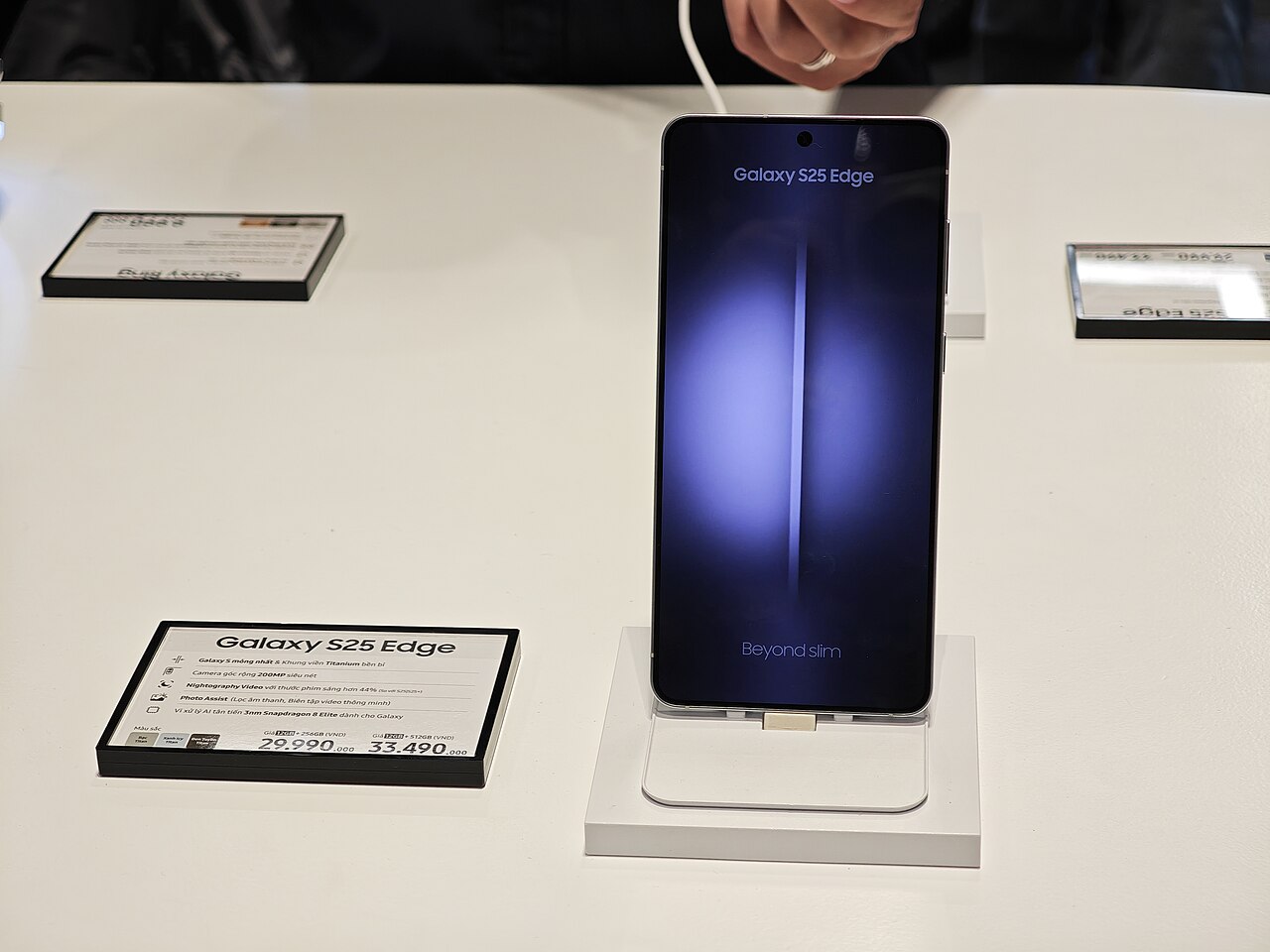
Most phone launches are about adding: another lens, a bigger battery, a faster chip. The Galaxy S25 Edge, announced on May 13, 2025 and released on May 30, 2025, was about subtracting. Samsung took a Galaxy S25 Plus-sized screen and put it in a body just 5.8mm thick, then accepted a smaller battery and a shorter list of cameras as the price of admission. It was the first Edge-branded Galaxy since the S7 Edge, and the thinnest Samsung phone in years. This page looks at the published specifications, explains where the compromises fall, and helps you decide whether a phone built around thinness is right for you. It is a specification-based analysis and not a laboratory test.
A Phone Defined by Its Thickness
The headline number is 5.8mm. For comparison, the standard Galaxy S25 is 7.2mm thick and the S25 Ultra is 8.2mm, so the Edge is about a millimetre and a half thinner than the S25+ and roughly two and a half millimetres thinner than the Ultra. Overall dimensions are 158.2 x 75.6 x 5.8mm, and the phone weighs 163 grams, only one gram more than the smaller Galaxy S25 despite having a much larger 6.7-inch display. That combination is what the phone is really selling: a large screen without the weight that usually comes with one.
The frame is titanium, which is a sensible choice when an engineer needs stiffness in a very slim body. The front glass is Corning Gorilla Glass Ceramic 2, a different formulation from the glass used on the S25 and S25+. Colors follow the metal theme, with the phone offered as Titanium Icy Blue, Titanium Silver and Titanium Jet Black. Water and dust resistance is rated IP68, meaning it can withstand immersion in up to 1.5 metres of water for 30 minutes. If you are curious about how those ratings work and what they do not cover, read our explainer on IP68 and MIL-STD-810H durability ratings.
Display
The display is a 6.7-inch Dynamic LTPO AMOLED 2X panel at 3120 x 1440 resolution, around 513 pixels per inch, with a refresh rate that scales from 1Hz to 120Hz and a peak brightness of around 2600 nits. It supports HDR10+ and has an ultrasonic fingerprint sensor built into the screen. It shares its resolution with the S25+ and the S25 Ultra, and includes the ProScaler upscaling technology that improves how lower-resolution video looks on the high-resolution panel. On paper this is a top-tier display; the thin body has not cost you screen specification. A flat 6.7-inch screen is also easy to use with a case and screen protector, which is a consideration when the frame itself is so slim.
Performance and Cooling
Like the rest of the S25 family (except the FE model), the Edge uses the Snapdragon 8 Elite for Galaxy, a 3nm processor with two performance cores at up to 4.47GHz and six efficiency cores at up to 3.53GHz, plus an Adreno 830 graphics processor. Unlike earlier generations, Samsung used the same chip in every region for this series. Memory is 12GB, and storage options are 256GB and 512GB using UFS 4.0; there is no 128GB version.
Putting a flagship chip in a phone this thin raises an obvious question about heat. Samsung's answer, according to the published description, is a vapor chamber with a thinner, wider surface area, designed to fit the slim body. A vapor chamber spreads heat across a larger area so that it can be shed through the frame and back. It is the kind of component that makes a big difference in sustained tasks such as long gaming sessions, video export or hours of navigation, and it is also where a thin phone is most likely to trade something away. We have not measured sustained performance on this device, so we are not claiming results. If you plan heavy gaming, check independent throttling tests first, and our explainer on why phones throttle gives you the vocabulary to interpret them.
Cameras: Two Lenses, One Big Sensor
The Edge is the first Galaxy S phone since the S10e to have only two rear cameras. The main camera is a 200MP sensor with an f/1.7 aperture and a 1/1.3-inch sensor size, with optical stabilization and multi-directional phase-detection autofocus. It is the same primary camera specification as on the S25 Ultra. Beside it is a 12MP ultrawide camera with a 120 degree field of view. The front camera is a 12MP unit at f/2.2. All S25 models can record 8K video at up to 30 frames per second and include Super Steady stabilization.
What is missing is any telephoto lens. The standard S25 and S25+ have a 3x telephoto, and the Ultra has both 3x and 5x, but anything beyond 1x has to come from cropping into the high-resolution main sensor. A 200MP sensor gives that approach more room than a lower-resolution one, since the camera can crop into the middle of the image and still retain a lot of pixels, but a crop is not the same as optical zoom, and results at longer distances will depend heavily on lighting. If you frequently photograph pets at a distance, concerts or your children playing sports, that gap matters, and the Ultra covers it far better. If your photography is mostly landscapes, food, friends and family within a few metres, the two-lens setup will probably suit you fine.
Battery and Charging: The Real Compromise
The trade-off that most affects everyday life is the battery. It is a 3900mAh cell, smaller than the 4000mAh in the standard S25 and much smaller than the 4900mAh in the S25+ that shares its screen size. Wired charging is 25W, the same as the standard S25, while the S25+ and Ultra support 45W. Wireless charging follows the Qi2 standard at up to 15W, and reverse wireless charging at 4.5W is available for accessories. Samsung has pointed to the efficiency of the Snapdragon chip as a way to help battery life on the ultra-slim phone, but the honest summary is that you should expect this to be the endurance laggard of the 6.7-inch S25 models on paper. Heavy users should plan for a top-up during the day and consider carrying a small power bank. Our guide to how batteries degrade over time is also relevant here, because a smaller battery is cycled more often and ages faster if you charge it daily.
Connectivity and Software
The Edge supports Wi-Fi 7, Bluetooth 5.4 and ultra-wideband, and international models offer dual nano-SIM plus eSIM, while US models have a single nano-SIM slot with dual eSIM. It launched with Android 15 and One UI 7.0 and has since been updated to Android 16 with One UI 8.5. Samsung's recent flagships have carried long update promises, so confirm the exact support end date for your region on the product page before buying. Audio is handled by stereo speakers with Dolby Atmos.
What Happened Next
An interesting footnote is that the Edge did not get a direct successor. The Galaxy S26 series that arrived in 2026 was announced in three core models (S26, S26+ and S26 Ultra) plus an FE variant, and no Edge. That does not make the S25 Edge a worse phone, but it does mean it is a distinctive one-off, and buyers should think of it as such.
Who Should Buy It
The Galaxy S25 Edge suits someone who values how a phone feels in the hand and pocket more than how many lenses it has, who takes most photos at wide-to-normal range, and who does not mind topping up the battery. It is a poor fit for heavy gamers, frequent travellers who lean on their phone all day, and anyone who wants optical zoom. If you want the biggest screen with the best camera hardware, the Galaxy S25 Ultra is the natural alternative, and it is also the safer choice for anyone worried about battery longevity. The Edge's titanium frame also raises the broader question of whether metal choice matters, which we cover in our piece on whether titanium phones are worth it.
Verdict
The Galaxy S25 Edge is an engineering statement more than a value proposition. It delivers a top-tier screen, a flagship processor and a 200MP main camera in a body that is noticeably thinner than anything else in the range, and it pays for that with a small battery, slower charging and no telephoto lens. If thinness is what you want, it does what it promises. If you want the most capable Galaxy, this is not it. We have not tested the phone ourselves, so verify battery and thermal behavior in independent testing before you commit.