Samsung Galaxy S26 Review: The Compact Flagship With a Regional Chip Split
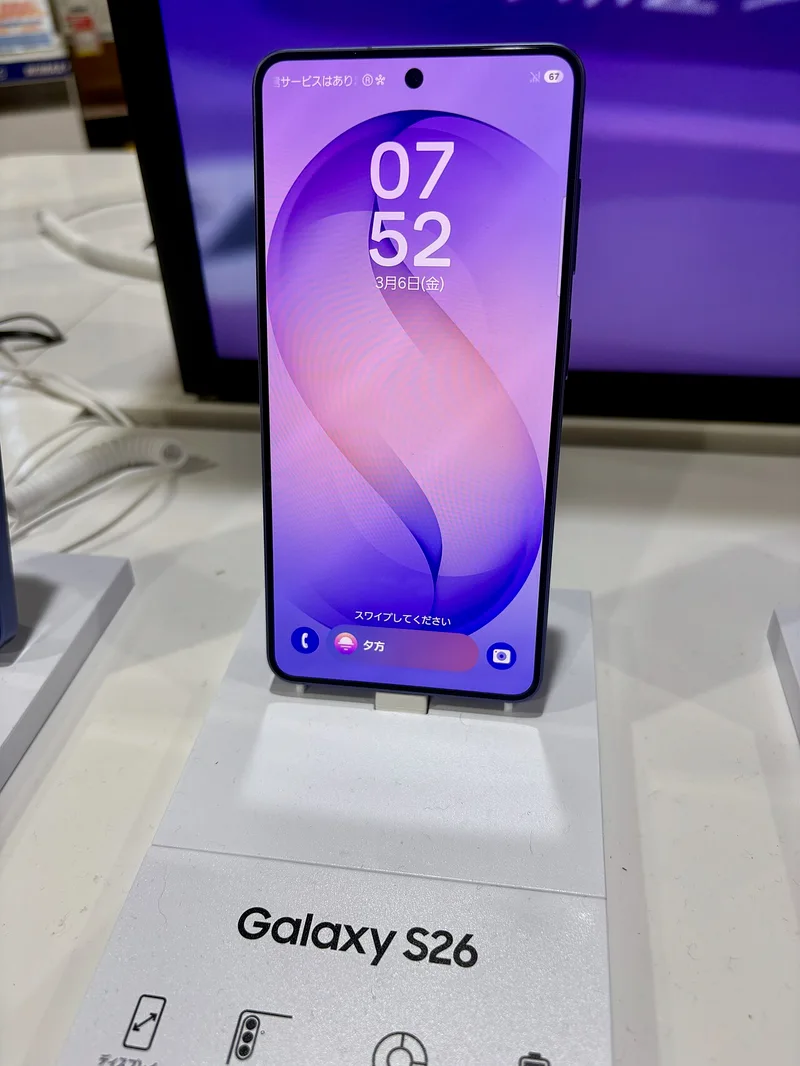
The standard Galaxy S26 is the phone most Samsung buyers will actually consider, because it is the smallest of the three core S26 models and the one that fits most comfortably in a normal pocket. It launched on March 11, 2026 alongside the S26+ and the S26 Ultra, and Samsung's approach this year was to leave the camera hardware alone while adjusting the display size, the battery and the chipset arrangement. That makes it a phone where the details matter more than the headlines. This page reads through the published specifications, explains what each change means for everyday use, and points out the caveats worth knowing before you buy. It is a specification-based review, not a lab test.
Size, Weight and Build
The S26 has a flat 6.3-inch display, a small step up from the 6.2 inches of the Galaxy S25. Overall dimensions are 149.6 x 71.7 x 7.2mm and the weight is 167 grams. Those numbers put it clearly in the compact-flagship category: narrow enough for one-handed use for most people, and light enough that it does not feel like a brick in a shirt pocket. It is only slightly heavier than last year's model at 162 grams, and the extra few grams come with a larger battery, which is a trade most buyers will accept.
The frame is aluminium, the back is glass, and Corning Gorilla Glass Victus 2 covers both the front and the rear. That is a familiar formula for the standard S-series phones, and it is sensible: aluminium keeps weight down while glass on the back supports wireless charging. The Ultra model is the one that gets the tougher Gorilla Armor 2 glass, so if you are hard on your phones, the base S26 is best paired with a decent case. The phone is sold in Black, Cobalt Violet, Sky Blue and White, and Silver Shadow and Pink Gold are available as online-store exclusives. If you like the idea of this size class in general, our roundup of compact flagship phones looks at how small phones have changed.
Display
The screen is a Dynamic LTPO AMOLED 2X panel at 2340 x 1080 resolution, about 411 pixels per inch, with a refresh rate that can go anywhere between 1Hz and 120Hz and a peak brightness of about 2600 nits with HDR10+ support. The resolution is full HD-plus rather than the higher 3120 x 1440 used by the larger S26+ and Ultra. On a 6.3-inch panel that is a reasonable choice: pixel density is high enough that text looks crisp at normal viewing distance, and the lower pixel count is easier on both the battery and the graphics processor. An ultrasonic fingerprint sensor is built into the screen.
Two display features of the Ultra are missing here. The base S26 does not get the ProScaler upscaling that the higher-resolution models use, which is not surprising given that its panel resolution is lower. It also lacks the Privacy Display that is exclusive to the Galaxy S26 Ultra. Neither omission is a deal breaker, but if you handle sensitive information in public places regularly, know that this is a feature you would be giving up by choosing the smaller phone.
Chipset: Snapdragon or Exynos, Depending on Where You Live
This is the single most important thing to understand about the S26 before you buy one. Samsung has brought back a regional split. In North America, China and Japan, the S26 uses the Snapdragon 8 Elite Gen 5 for Galaxy, built on a 3nm process, with the Adreno 840 graphics processor. In the rest of the world, it uses Samsung's own Exynos 2600, built on a 2nm process, with Xclipse 960 graphics. The S26+ follows the same split, while the Ultra uses the Snapdragon chip everywhere.
Both chips are described as flagship-class, and nothing in the published material lets us rank one above the other, so we will not pretend to. What buyers can do is check which version is sold in their market and read independent sustained-performance and battery tests for that specific chip before purchasing. If you regularly import phones or buy from a different region, be aware that you may end up with the other processor. Memory and storage are the same regardless of chip: 12GB of RAM and either 256GB or 512GB of UFS 4.0 storage. The base 128GB option from the previous generation has been dropped, which raises the entry storage but also means the phone starts at a more comfortable capacity for photos and video.
Cameras: Familiar Hardware
The rear camera system is unchanged from the S25 and S25+: a 50MP main camera at f/1.8, a 12MP ultrawide with a 120 degree field of view, and a 10MP telephoto offering 3x optical zoom at f/2.4. The front camera is a 12MP unit at f/2.2. All models in the family can record 8K video at up to 30 frames per second, and the Super Steady video mode now includes a Horizon Lock option that keeps the horizon level even if the phone rotates, up to a full 360 degrees, with support for up to 4K recording. Image processing is handled by Samsung's ProVisual Engine.
The main takeaway is what is not new. If you own an S25 or S25+ and are hoping for a sensor upgrade, this is not that phone. The 3x telephoto is a comfortable range for portraits and for framing subjects across a room, but it does not reach as far as the 5x lens found on the Ultra. That is the real dividing line between the models for people who care about photography: the standard S26 covers everyday shooting well on paper, while the Ultra is the phone for long zoom and the largest sensor.
Battery and Charging
The battery grows from 4000mAh to 4300mAh, a 300mAh increase that is meaningful for a phone this size. Wired charging tops out at 25W, the slowest of the three main S26 models, since the S26+ supports 45W and the Ultra reaches 60W. Wireless charging is rated at 15W under the Qi2.2 standard, and the phone can share power in reverse at 4.5W. As with the Ultra, there are no magnets built into the phone to align a Qi2 charger, so buyers who want magnetic accessories should look for a case that adds them. Our explainer on Qi2 wireless charging on Android covers what that means in practice.
The 25W wired figure is worth putting in context. It is not slow, and it is very typical for a compact phone, but people who have used phones with far higher wired speeds will notice the difference when topping up quickly. It is one of the trade-offs of choosing the smaller phone. Battery life depends on which chipset you get, which is another reason to read regional tests.
Connectivity and Software
The S26 supports Wi-Fi 7, Bluetooth 5.4, NFC and USB-C 3.2 at 5Gbps. Ultra-wideband is not included on the base model; it is limited to the S26+ and the Ultra, which matters if you plan to use precise item-finding or digital car keys, which can depend on it. The phone launched with Android 16 and One UI 8.5, and Samsung has promised seven years of operating system and security updates, ending in 2033. Android 17 with One UI 9.0 arrived in September 2026. That commitment is among the longest in the industry and, for a phone in this price tier, it is a strong reason to consider buying and holding. For a wider look at how different companies handle support, see our article on software update commitments.
Who Should Buy It
The Galaxy S26 is best for someone who wants a small, light flagship with a bright, smooth display, a solid three-camera setup and a long support promise, and who does not need the zoom range, the S Pen or the privacy screen. It is a natural upgrade for someone on a phone from three or four years ago. If you already have the S25, the changes are modest: a slightly larger screen, a bigger battery and a new chip. If you want fast charging or the best possible camera, the S26+ and the Ultra deserve a look.
Verdict
The Galaxy S26 is a conservative but sensible update. Its strengths are size, weight, a bright LTPO display and a seven-year software promise; its weaknesses are unchanged cameras, the slowest wired charging in the family and a chipset that depends on your region. Because we have not run our own tests, we would not make a purchase decision on battery life or sustained performance without checking independent measurements for the version sold where you live. As a specification package, though, it earns a place on the shortlist of anyone who values a compact flagship.