Samsung Galaxy S26 Ultra Review: Thinner, Lighter and Private by Design
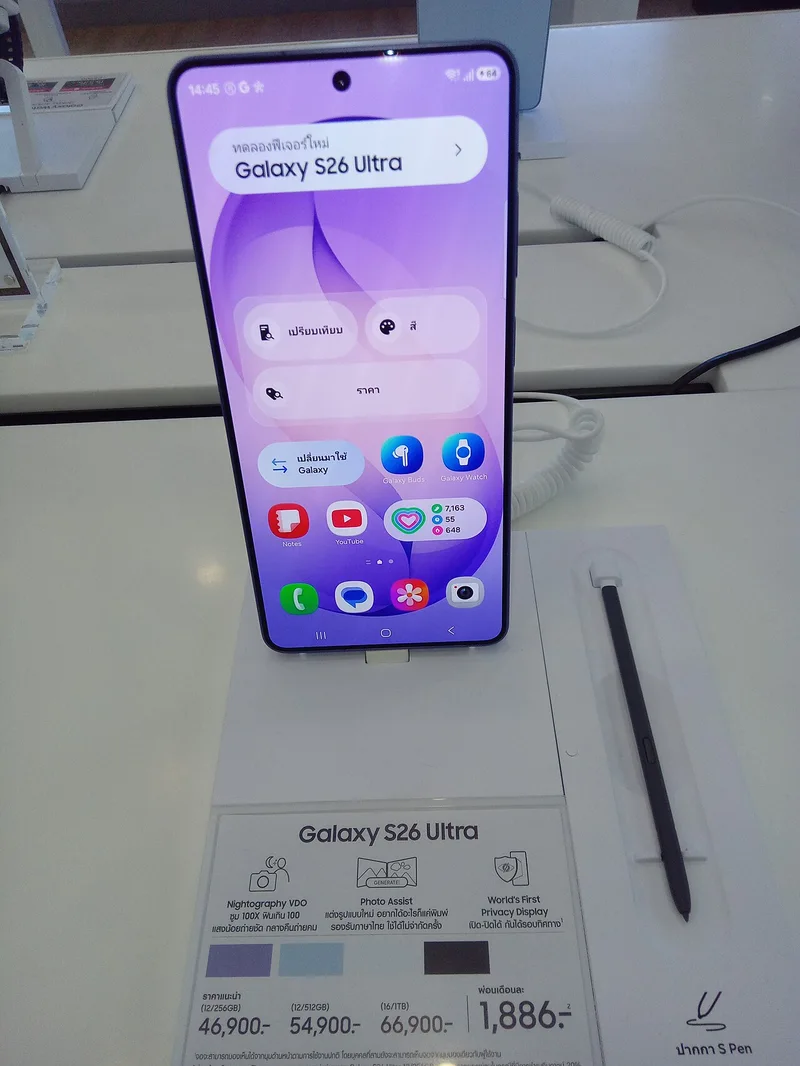
Samsung's Galaxy S26 Ultra arrived in March 2026 with a shorter list of headline changes than some previous generations, but the items on that list are the sort that change how a phone is used day to day: a display that can narrow its own viewing angle, a wider-aperture main camera, faster wired charging than any earlier Galaxy, and a body that is thinner and lighter than last year's Ultra. This page walks through what the published specifications say about each of those areas, what they mean in practice, and who should care. It is a specification-based analysis rather than a lab test, so where a number is not published we say so instead of guessing.
Where the S26 Ultra Sits in the Lineup
The Galaxy S26 family was announced on February 25, 2026 at a Galaxy Unpacked event in San Francisco and went on sale on March 11, 2026. The Ultra is the top model, sitting above the Galaxy S26 and the S26+, and it is the only one with a built-in S Pen and its own silo in the frame. It is also the only one of the three core models that uses the same Snapdragon chip in every region. The smaller S26 and S26+ split their chipsets by market, which makes the Ultra the simplest one to recommend without asking where the buyer lives.
Design: Thinner, Lighter, and Back to Aluminium
The most visible physical change is the frame. The previous Ultra used titanium; the S26 Ultra returns to an aluminium frame, the material last used on the Galaxy S23 Ultra, wrapped around a glass back with more rounded corners than before. Some buyers will read that as a downgrade on paper, but the practical effect is modest. The published dimensions show the result: 163.6 x 78.1 x 7.9mm, compared with 8.2mm thick for the S25 Ultra. At 214 grams it is also about four grams lighter than its predecessor despite a larger footprint. That makes the S26 Ultra the thinnest Ultra Samsung has built in the S-series, which matters for pocket comfort even if it will never show up on a benchmark chart.
Protection glass is Corning Gorilla Armor 2 on the front and on the rear panel. Gorilla Armor is the tougher, lower-reflection variant, and putting it on both sides is a sensible choice for a phone that will spend most of its life in a pocket or a bag. The phone is offered in Black, Cobalt Violet, Sky Blue and White, with Silver Shadow and Pink Gold available as online-store exclusives.
The Privacy Display
The feature most likely to be discussed in coffee shops and on trains is Privacy Display. Developed by Samsung Display under the working name Flex Magic Pixel, it changes how the panel emits light so that, when enabled, the screen is much harder to read from the side while looking normal to the person holding the phone. The important engineering point is that it is built into the panel rather than laid on top as a film. Traditional privacy screen protectors add a polarizing layer that tends to dim the image and can soften it even when you do not need privacy. A panel-level approach means the display can behave normally the rest of the time.
It is also selective. The feature can be switched on or off in settings, and it can be applied only to certain parts of the screen, such as notification pop-ups, or only to particular apps where you handle sensitive information such as banking or messages. That granularity is the part worth thinking about before you buy. If you commute, work in an open office or often handle client data on your phone, this is a real functional advantage. If you mostly use your phone at home, it becomes a nice-to-have. It has been described as a first for a smartphone, and the specification sheet lists it as exclusive to the Ultra; the S26 and S26+ do not have it.
Display Specifications
Beyond privacy, the panel is a 6.9-inch Dynamic LTPO AMOLED 2X at 3120 x 1440 resolution, which works out to roughly 500 pixels per inch. Refresh rate scales from 1Hz to 120Hz, and peak brightness is quoted at about 2600 nits with HDR10+ support. An ultrasonic fingerprint sensor sits under the glass. The variable refresh range is the part that affects battery life: static content such as an always-on clock or a paused e-book page can run at the bottom of the range, while scrolling and games use the top. If you want a primer on why that matters, read our piece on LTPO adaptive refresh rate displays.
Performance and Memory
Inside is the Snapdragon 8 Elite Gen 5 for Galaxy, built on a 3nm process, paired with the Adreno 840 graphics processor. Memory is 12GB in most configurations, with 16GB on the 1TB model, and storage options are 256GB, 512GB and 1TB using UFS 4.0. Because the same chip is used worldwide, buyers do not have to check which processor their regional model carries, something that is not true of the smaller S26 and S26+.
Sustained performance depends on cooling as much as on the chip, and no sustained-load figures are published in the materials we relied on, so we are not going to quote any. What can be said is that a 7.9mm body has less room for heat spreading than a thicker one, which is one reason careful buyers should look at long-session behavior in independent reviews before assuming peak numbers hold indefinitely.
Cameras
The rear system has four lenses. The main camera is a 200MP sensor with an f/1.4 aperture, a jump from f/1.7 on the previous model. A wider aperture lets more light reach the sensor in the same exposure time, which generally helps low-light photos and can produce more natural background blur at close distances. Alongside it are a 50MP ultrawide with a 120 degree field of view, a 10MP telephoto at 3x optical zoom (f/2.4), and a 50MP telephoto at 5x optical zoom with an f/2.9 aperture, wider than the f/3.4 of last year's equivalent.
The 5x lens uses a mechanism Samsung calls All Lens On Prism rather than the conventional periscope arrangement found on earlier models. Combined with the 3x lens, it gives the phone two dependable optical steps between the main camera and the deep digital zoom range, which Samsung brands Space Zoom and rates up to 100x. Treat the extreme end of that range as a convenience for reading distant signs rather than a way to take keepsake photos. For a deeper look at how long lenses work, see our roundup of the best zoom camera phones.
On the video side, the phone records up to 8K at 30 frames per second, and Super Steady mode includes a Horizon Lock option that keeps the horizon level even when the phone is tilted or rotated, including a full 360 degree rotation, with support up to 4K. That is a useful tool for action footage and walking shots. The front camera is a 12MP unit at f/2.2, unchanged from the previous generation. Image processing runs through Samsung's ProVisual Engine.
Battery and Charging
The battery is rated at 5000mAh, the same capacity as before, so any change in endurance will come from efficiency rather than size. The bigger story is speed: the S26 Ultra supports 60W wired charging, the fastest wired rate ever offered on a Galaxy phone, and 25W wireless charging under the Qi2.2 standard. Reverse wireless charging is rated at 4.5W for topping up earbuds or a watch. One detail that surprises some buyers is that, although the phone supports the Qi2 protocol, it does not include the built-in magnets that the standard uses for alignment, because they would interfere with the S Pen and the camera arrangement. If you rely on magnetic mounts, plan on a case with a magnetic ring. To understand how wattage claims translate into real charging habits, our explainer on fast-charging wattage and GaN chargers is a good companion read.
Connectivity and Software
The phone supports Wi-Fi 7, Bluetooth 6.0, NFC, ultra-wideband and USB-C 3.2 at 5Gbps. It shipped with Android 16 and One UI 8.5, and Samsung has promised seven years of operating system and security updates, which runs into 2033. Android 17 with One UI 9.0 followed in September 2026. A seven-year window is one of the strongest commitments in the Android world and is a genuine argument for paying flagship money, because it lowers the yearly cost of ownership.
Who Should Buy It
The S26 Ultra makes the most sense for someone who wants the largest screen, the most flexible camera kit and the S Pen in one device, and who will keep the phone for many years. The Privacy Display is the tie-breaker for anyone who handles sensitive information in public. It makes less sense if you prefer a compact phone, in which case the smaller S26 is the more natural pick, or if you are upgrading from the S25 Ultra: the hardware changes are evolutionary, and a careful look at what you would actually gain is a better guide to that decision than any spec table.
Verdict
On paper the Galaxy S26 Ultra is a refinement release: thinner, lighter, faster to charge and with a wider-aperture camera, plus one genuinely new idea in Privacy Display. The move from titanium back to aluminium will bother spec-sheet purists more than everyday users. We have not published test results for this phone, so battery life, camera output and sustained performance should be confirmed against independent testing before you decide. If those numbers hold up, this is a very complete flagship with the longest update promise you can buy.